01-B: Airworthiness Requirements
Knowledge
K1: General airworthiness requirements and compliance for airplanes
K1a: Location and expiration dates of required aircraft certificates
- ARROW
- Airworthiness certificate
- must be openly displayed (it is the first letter in the acronym, thus the most important)
- valid as long as maintenance is performed compliantly
- airworthiness requirements
- airworthiness certificate
- type design conformity (valid maintenance, inoperative equipment procedures inkl. placards)
- safe conditions for flight (as determined per preflight)
- Registration
- valid for 7 years
- must be updated after an aircraft sale, even before doing a ferry flight to the pilot's home airport
- on board
- Radio station license
- only required for international flights
- Operating limitations
- in the FAA-approved POH
- Weight and balance data, comprising 1) POH section on weight and balance data 2) current weight and balance report updating the POH data
- Airworthiness certificate
K1b: Required inspections and airplane logbook documentation
- responsibilities
- owner's or operator's responsibility
- maintaining an aircraft in airthworthy condition
- other
- have an aiworthiness certificate
- have an aircraft registration
- have an aircraft radio station license if needed
- perform maintenance (incl. AD compliance)
- record maintenance
- inform FAA of aircraft sale
- inform FAA about personal status (address, citizenship)
- PIC's responsibility
- ensuring the safety (and thus airworthiness) of the aircraft prior to the flight
- owner's or operator's responsibility
- Main components that require inspections
- Airframe
- Power plant
- Prop
- Avionics
- Required main component inspections:
- 100 hour inspections
- if aircraft is used for hire or flight instruction
- can be exceeded by 10 hours, but the next 100-hour inspection still is required 100h after the actual due date (to avoid incentivizing late inspections)
- flight training in private aircraft does not require 100 hour inspections
- can be performed by any airframe and powerplant mechanic
- annual (every aircraft certified by the FAA)
- must be performed by an A&P mechanic with Inspection Authority (IA)
- 100 hour inspections
- Individual components that require inspections or replacement
- ELT [starts with E… Eins, … ein Jahr und eine Stunde; transmits on 121.5]
- Inspected
- every 12 months
- replaced
- After 1h of continued operation or below half battery life
- tested
- during the first 5 minutes past the hour
- other mnemonic:
- 121.5 -> 12|1|.5
- must be inspected every 12 months
- must be replaced every 1 hour of cumulative use or after .5 of the battery life
- Inspected
- Transponder (part 43) [transponder… starts with T… every two years]
- Inspected
- every 24 months
- Inspected
- Altimeter and static system within the last 24 calendar months (91.411)
- Parachutes
- packed in the preceding 180 days for synthetic mateiral
- packed in the preceding 60 days for natural materials (silk, fiber, pongee)
- VOR (IFR only), tested within the last 30 days
- ELT [starts with E… Eins, … ein Jahr und eine Stunde; transmits on 121.5]
- mnemonic: AV1ATE
- Annual
- VOR
- 100
- Altimeter and pitot-static system
- Transponder
- ELT
- preventive maintenance
- actions are exhaustively defined in Part 43, Appendix A
- can be performed and approved by a private pilot or above
- must be documented with signature, certificate number, kind of certificate
- potential change of flight characteristics
- require a test flight
- of at least a private pilot
- without any passengers
- (compensation/hire without passengers is ok)
- require a test flight
K1c: Airworthiness directives and special airworthiness information bulletins
-
https://drs.faa.gov/browse/ADFRAWD/doctypeDetails?Status=Current&Make=Cessna%20Aircraft%20Company&Model=172
-
AD compliance must be ensured by the owner/operator
- AD compliance must be documented in the logbook
- for one time ADs: with the AD number, revision date, and compliance method
- for recurring ADs: additionally with the time and date of the next required action
- AD types
- emergency ADs (fleet groundings)
- non-urgent ADs
- type certificate sheets
- type certificate data sheet (TCDS)
- lists airworthiness properties of an aircraft as part of the manufacturer's aircraft development process
- supplemental type certificate (STC)
- updates to the TCDS
- type certificate data sheet (TCDS)
K1d: Purpose and procedure for obtaining a special flight permit
- purpose:
- performing flights that would normally not be compliant with ADs or regulations, but are generally safe for flight, e.g.,
- ferry flights to a repair base
- performing flights that would normally not be compliant with ADs or regulations, but are generally safe for flight, e.g.,
- obtaining a special flight permit:
- provide exact aircraft, route, and crew data to the FSDO or Designated Airworthiness Representative
K2: Pilot-performed preventive maintenance
- exhaustive list of preventive maintenance actions provided in FAR Part 43, Appendix A c)
- can be performed by a private pilot
- must be logged in the maintenance logbook
K3: Equipment requirements for day and night VFR flight
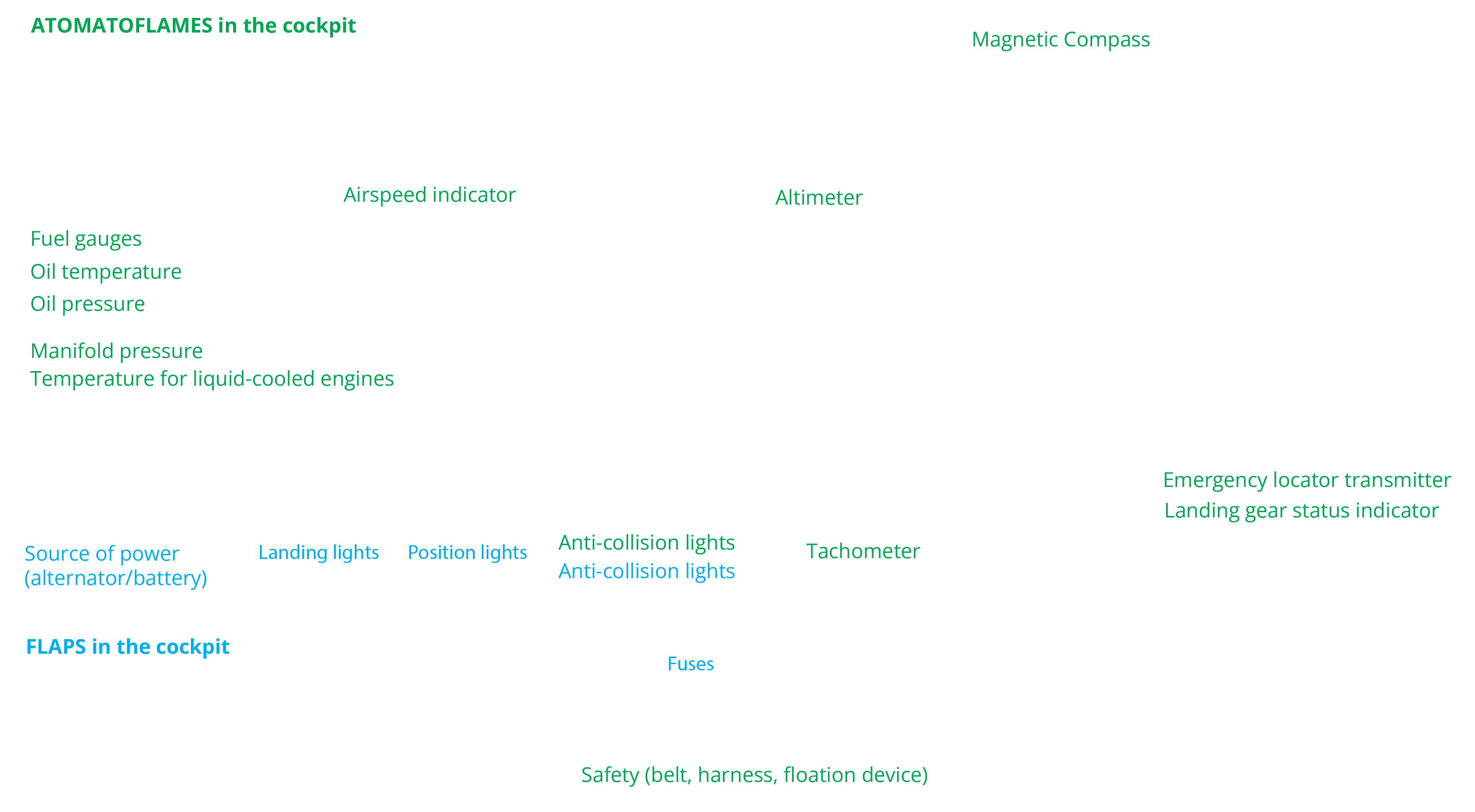 ATOMATOFLAMES
K3a: Flying with inoperative equipment
K3b: Using an approved minimum equipment list (MEL)
- copy ForeFlight procedure
K3c: Kinds of Operation Equipment List
K3d: Required discrepancy records or placards
- listed in the POH limitations section
K4: Standard and special airworthiness certificates and their associated operational limits
- Standard ADs:
- can be searched on the FAA Dynamic Regulatory System webpage:
- https://drs.faa.gov/browse/ADFRAWD/doctypeDetails?Status=Current&Make=Cessna%20Aircraft%20Company&Model=172
- can be searched on the FAA Dynamic Regulatory System webpage:
- experimental or special light-sport aircraft (pink instead of white paper)
- experimental operating limitations are part of the airworthiness certificate
- the operating limitations must be attached to the special airworthiness certificate (Form 8130-7)
- do not have an FAA-approve flight manual
- cannot be flown over densely populated areas or in congested airways
- restricted category civili aircraft
- cannot be flown over densely populated areas